Showing posts with label United Kingdom. Show all posts

Wednesday, April 9, 2014

Left Out in the Cold: The Problematic Partial Inclusion of Europe’s East

Europe will always be unfinished, because it is an idea as much as a geographic expression, and a rather idealistic one at that.

The European Union and a few countries which opted not to join, like Switzerland, Norway, and Iceland, have their problems – structural economic imbalances in the EU which threaten its sustainability, nationalism on the rise, democratic regression in countries like Hungary and Romania – but overall these countries are still among the wealthiest and the freest in the world.

The geographical dilemmas of completing a Europe “whole, free, and at peace” remain, however. The peninsulas and islands jutting into the northeastern Atlantic can be pretty sure they’re part of Europe, as can anyone living anywhere near the Alps. But the seas and straits between Gibraltar and the Caucasus and the Ural Mountains are a pretty arbitrary divide. The problem of only partial inclusion in Europe has been particularly damaging for the more than 260 million citizens of the Russian Federation, Turkey, and Ukraine.

The EU has its reasons to consolidate its troubled project rather than continue to expand to new countries. However, Western Europe has a record of sending contradictory messages to the countries in the continent’s east. These include extending candidate status to Turkey in 2005, then electing Angela Merkel and Nicolas Sarkozy with their “privileged partnership” and non for Ankara; refusing to confirm the potential of future membership for Ukraine and Moldova, despite the EU treaties opening such potential to “any European State” which respects European values; expanding visa-free travel to all the Christian countries in the Balkans before any of the Muslim countries; and rhetoric from European Council President Herman Van Rompuy about European unification’s roots in Middle Ages Latin Christianity, which dismayed Bulgaria. 

With Catholic Croatia now safely in the EU, 23 years after Germany unilaterally recognized its declaration of independence, and the four Eastern Christian countries in the bloc (Greece, Cyprus, Bulgaria, and Romania) in not particularly good standing in the eyes of the older member states, many EU citizens would be happy to keep these borders. These are the realities of how a union of 28 disparate democracies handles the prospect of extending pooled sovereignty to some of more than a dozen countries further east. These nations are seen as less culturally similar to the older member states. Some are quite large, some quite small. They are fragile democracies at best, many fractured, several with breakaway enclaves. All are relatively poor. But ambivalence in EU capitals and mixed messages sent by Western European leaders imposes real costs and dilemmas on the democrats of Turkey, Ukraine, Moldova, Georgia, Serbia, Kosovo, Macedonia, Bosnia and Herzegovina, and other countries.

Extending the hugely successful European integration project to the east was always going to be a huge challenge. There are many reasons to call Europe’s eastern neighborhood policy a great success – the EU has absorbed 11 former communist countries (12 when you include East Germany), with over 100 million people. But some clear failings are seen with the three big countries in Europe’s eastern reaches. Although Russia and Turkey have had a good 21st century in many respects, with incomes and international influence steadily rising since the year 2000, it is not surprising that both of them as well as Ukraine have seen massive protests by pro-democracy / pro-Western citizens in the last three years, which autocratic leaders attempted to crush.

Russia, with 142 million people, was always too big and proud to join the EU. But Russia is clearly a part of modern Europe in many ways – economically integrated, if mostly as a source of energy sent through pipelines and oligarch’s cash spent in London and Switzerland, a member of political groupings such as the Council of Europe and Organization for Security and Cooperation in Europe, a participant in Eurovision and UEFA soccer tournaments. However, democracy failed in Russia, damaged by the chaos of the wild 90s and then smothered in the Putin era by an elite prioritizing its personal short-term interests and willing to ignore a clear long-term downward trajectory masked by high energy prices. European companies and many leaders – above all in Germany and the City of London – tried to look past Russia’s democratic failings and corruption. But if Berlin’s “Annäherung durch Verflechtung” (rapprochement through interdependence) worked, “Wandel durch Handel” (change through trade) failed. Vladimir Putin watched as NATO expanded to Russia’s borders (as was the right thing to do – the Baltics had very good cause to want NATO membership), watched the Western intervention in Kosovo (again, the right thing to do in the face of ethnic cleansing), watched the U.S. invade Iraq (a grievous mistake in which the U.S. ignored some of Putin’s better advice), and suffered a major political defeat in Ukraine’s Orange Revolution. Putin’s anti-Western side was stoked and he transformed from a awkward partner of the West to an adversary. Russia took actions to destabilize its neighbors whenever they tried to move closer to the EU and the United States. Those who claim that the Obama Administration’s “reset” policy was wrongheaded are unrealistic or ideologues – it was necessary to try to mend ties with Russia and progress was made on nuclear reductions, Russian membership in the World Trade Organization, cooperation on Afghanistan, Iran, and Libya. Dmitry Medvedev was not completely a puppet as president. But in 2011 Putin announced he had decided to return to the presidency – a historic mistake for Russia – and responded to subsequent protests with greater repression. At the same time, Russia backed the Assad regime in Syria to the hilt as its killed tens of thousands of its citizens and radicalized the opposition. Washington – and importantly Berlin – have rightly responded with more vocal criticism of Putin and his regime.

Turkey, with a fast-growing population of 80 million, is about to surpass Germany on the population table. Many Europeans see it as too big, too poor, and too Muslim to join the family. Turkish membership would change the EU, and for EU citizens and leaders who follow the polls, the negatives of such a change outweighed the positives – greater diversity, stronger demographics, etc. – which required greater imagination to see. The arguments of those who saw the benefits were drowned out. Turkey’s candidacy has effectively been dead for years, buried by the hard opposition of several member states and ultimately by the subsequent actions of the increasingly dictatorial Recep Tayyip Erdoğan. For many years, Erdoğan advanced democracy in Turkey by pursuing European integration and civilian control of the military. But his uglier side has been unavoidable in the last year, as his response to the Gezi Park protestors made clear to the world that he had a purely majoritarian view of democracy and did not respect those of his countrymen who disagreed with him. Challenged by a corruption scandal, Erdoğan has responded with purges in the criminal justice system and banning Twitter. He may have substantial support, as the most recent elections again confirmed, but at this point he is clearly damaging Turkey’s democracy.

Ukraine, with 44 million people, is where the autocrats – Putin as well as Viktor Yanukovych – failed. Corruption is even worse in Ukraine than in Russia or Turkey and the country has been consistently misgoverned. Persistent Russian interference, often using its energy monopoly as weapon, has not helped. Critically, the EU has also refused to make clear whether or not Ukraine could ever become a member, limiting politicians’ appetite for reform. President Viktor Yushchenko made a mad dash for NATO membership, despite such a move (and his government) being unpopular within the country, but at the Bucharest Summit in 2008, Germany and France stopped a Bush Administration push to give Ukraine – and Georgia – a Membership Action Plan. Ukraine’s diversity gave it a more competitive and indeed chaotic political space than many of its fellow post-Soviet states, while it remained a fragile economy with terrible government finances and was walloped by the global economic crisis in 2008. In 2010, Yanukovych, rejected in the Orange Revolution, won a fair presidential election, then surprised many in the West with the aggressiveness of his monopolization of the levers of power. He also made moves which pleased Russia, like unconstitutionally extending the lease on the Black Sea Fleet’s base by 25 years. But with the EU offering an Association Agreement including a comprehensive free trade deal, Yanukovych balanced Brussels and Moscow for his own gain as long as he could. In November 2013, his time ran out, and he chose Moscow and gave impetus to the EuroMaidan protests. If he hadn’t used violence against the protests when they were relatively small and imposed draconian “dictatorship laws” in January 2014, Yanukovych might still be in power. Instead, he ended up fleeing in February after several bloody days in Kyiv and an abortive deal brokered by the EU. Ukraine swung west and an incensed Putin invaded and annexed Crimea. Now Ukraine faces major difficulties in maintaining control of its territory even without Crimea, given the activities of secessionists in the east directed and/or inspired by Moscow, while its economy remains on the brink of collapse, elections must be helped, and difficult economic reforms must be implemented.

So all three countries are severely troubled. Russia and Turkey look more autocratic than they have in decades, while Ukraine reached that point earlier in 2014 and currently remains at acute risk of state failure. All three are divided countries, their places in today’s Europe – which for people many means the EU, NATO, or both – are vexed. The reasons for this are manifold, the products of geography, history, economics, and domestic politics and foreign policy in dozens of countries. China’s economic performance over the past three decades has given autocracy a good name, while Putin’s model of so-called “sovereign democracy” has inspired imitators. The United States, leader of the free world, allowed its financial system to blow up the world economy, setting some countries back by a decade, and characteristically did nothing to deal with the root causes of the problem. Both the U.S. and the EU are distracted by internal problems, some very serious, and fatigued with foreign policy and enlargement. But Russia and Turkey heading fast in the wrong direction and Ukraine in chaos are very dangerous indeed for Europe and its allies across the Atlantic.

It is in the enlightened self-interest of Europe and the United States to help Ukraine stabilize and succeed as a less corrupt democracy in which citizens can meet their aspirations and to incentivize democratic development and European integration in Russia and Turkey. But success will require more creativity and generosity than has been in evidence in recent years. 

Thursday, April 28, 2011

Apparently the Royals Are Tories

The royal family invited to the wedding members of the unemployed royal families of Bulgaria, Greece, Romania and Yugoslavia (sic), various absolute monarchs (ie. dictators) from around the world (although the crown prince of Bahrain at least had the shame to decline to attend, not wanting to bring negative attention to the ceremony), representatives from Zimbabwe, North Korea and Yemen (although they did disinvite Syria and Malawi), former prime ministers Margaret Thatcher and John Major, both of the Conservative party, and Guy Ritchie, David Beckham, and Elton John, but not the previous two prime ministers Tony Blair and Gordon Brown or the UK's commissioner at the European Union, High Representative for Foreign Affairs and Security Policy Baroness Catherine Ashton, all of the Labour Party?

Ed Miliband at least did get an invite. I would suggest that after he enjoys some wedding cake, he should add to the Labour platform the abolition of the monarchy.

Let England Shake

"The West's asleep / Let England shake! / Weighted down with silent dead / I fear our blood won't rise again / England's dancing days are done..."

So Polly Jean Harvey sang a year ago on the Andrew Marr Show, accompanied by a strange stringed instrument and a looped sample of "Istanbul, Not Constantinople," her boa and hairdress suggesting a raven (leaving the tower?) while fellow guest Prime Minister Gordon Brown looked on. At the time Nick Clegg was "soaring" in the polls, Brown was calling voters "bigoted," and people weren't so sure about David Cameron and his friends. But soon the election results were in, Brown was out, and Britain had its first coalition government since the Second World War and its first government involving the Liberals since the Great War. Then came austerity.

Harvey's excellent new album Let England Shake was released a few months ago, and it's my favorite of the young decade (though the Arcade Fire and LCD Soundsystem albums from last year give it a run for its money). Written on an autoharp, it has a more ethereal sound than her punkish early work, it is catchy, accessible, poetic and interesting. The songs are about her native England and about war. Several songs refer to the failure at Gallipoli in 1916, others more generally to the trenches and battles of the Great War. "Written On the Forehead" is about Iraq. Harvey commissioned photographer Seamus Murphy to make short films in England for each song. Harvey explained the reading and research into conflict that preceded the recording of the album ("I was wanting to show the way that history repeats itself, and so in some ways it doesn't matter what time it was, because the endless cycle goes on and on and on... I started wondering where the officially appointed war songwriter was. You have got your war artists, like Steve McQueen, and your war photographers. I fantasized that I had been appointed this official songwriter and so I almost took on that challenge for myself,") and the Imperial War Museum offered to make her an official war song correspondent.

"Goddamn Europeans, take me back to beautiful England, and the grey, damp filthiness of ages and battered books and fog rolling down behind the mountains on the graveyards and dead sea-captains..."

Following Polly's advice, I returned to London, the center of the world, earlier this month after an eight year absence. When I studied there in college, Tony Blair took the United Kingdom into George W. Bush's Iraq War. I watched Bush, Blair, Jose Manuel Barroso and Jose Maria Aznar give Saddam Hussein their demands from the Azores. I marched through Hyde Park in the biggest war protest in decades. I was in Amsterdam on a field trip when the bombs started falling and I had never been more ashamed of my country. In April 2011, Tony Blair is long gone, his candidacy for President of the European Council laughed off the stage (though Barroso rules the Commission blocks away from where I live in Brussels). London had just seen the biggest protests since eight years ago, however, against the coalition government's austerity measures, breaking into small riots. Trafalgar Square had been cleaned up nicely, though. I arrived during a spell of lovely warm weather and there wasn't much of a hint that anything was wrong in England. Indeed, the tea towels had been printed for the April 29 royal wedding.

I enjoyed the Imperial War Museum, which is really worth an afternoon next time you're in London. But Harvey's album is timely, the present moment reminds you that Britain's glory is past, even as cosmopolitan London still feels like the center of the world. The United Kingdom is slowly but surely drifting apart into its constituent nations. Cameron, along with Nicolas Sarkozy, led Barack Obama into a "kinetic military action" in Libya, but within a few days Britain had used up a huge chunk of its missile stockpile. The government had to reconsider its defense budget cuts. The Arab Spring generally represents a crack-up of the mostly British-imposed post-Great War, post-Ottoman order of the Middle East (the shaping of which is excellently described in David Fromkin's A Peace to End All Peace, which I just read). Eight Arab royals, mostly from countries with long and close relationships to London, are attending William and Kate's wedding but the crown prince of Bahrain is staying away to avoid protests as the future of the house of Khalifa is threatened by protests. A relatively modern Gulf state - the first to diversify its economy away from energy - has fallen under martial law because killing its people is the only way for its 18th century monarchy to stay in power.

The Economist's Bagehot columnist last week took the occasion of the royal wedding to suggest a republic to prevent further class-based nastiness in England. Timothy Garton Ash admits that the monarchy doesn't work in democratic theory but has a heritage value, he asks if we'd prefer a President Blair in Buckingham Palace and points out rightly that "Rupert Murdoch is a far greater threat to British democracy than our hereditary head of state." There are probably decades to go before these bright young things take the throne as King William V and Queen Catherine. The forecast in London tomorrow is cloudy with a chance of rain.

Saturday, May 8, 2010

Touring Europe Without Leaving Washington

In April, skies blackened above Europe as Iceland's Eyjafjallajokull volcano spewed ash over an area of thousands of miles and as far away as Russia, causing the cancellation of nearly all flights to, from, and around the continent and, in short, utter chaos. Then the markets' confidence in Greece's ability to survive a sovereign debt crisis went from bad to nonexistent. European leaders eventually faced up to the existential nature of the crisis in the eurozone but contagion had already started to spread. Protests in Athens against austerity measures turned into deadly riots featuring Molotov cocktails. Then British voters delivered twin scary results for the country's economic stability and its place in Europe - a hung parliament and a Tory plurality. And the volcano has decided it isn't finished yet.

The state of Europe’s union is not strong. It is being sorely tested. Hopefully it will come through a tough couple years and be stronger than ever. On Saturday in Washington, DC, the EU was putting its best face forward, welcoming hordes of fascinated Americans and other citizens of the world into their 27 embassies plus the delegation of the EU itself for its annual Open House Day. As a theme, the embassies were encouraged to promote the EU’s relatively impressive record on alternative energy, which some took more seriously than others.

I made a day of it, and managed to exceed my own expectations, visiting seven embassies from 10 a.m. to 4 p.m. This was a cool opportunity - DC has upwards of 180 embassies, many with multiple buildings, packed into it, but I had only ever been inside one - that of the Russian Federation for a tribute Andrei Gromyko featuring Henry Kissinger. I began by walking down Florida Avenue towards Dupont Circle, my usual path to school, but kept going on Florida until I reached the cluster of embassies west of Dupont and east of Rock Creek. This is home to a third of the EU buildings as well as the delegations of a couple more countries which would like to be in the EU (Turkey, Albania, Moldova, which shares its building with one of my favorite restaurants and classy bars, Russia House). My friend Phil had worked in the US embassy in Estonia last summer and we met outside that cozy corner embassy at the intersection of Florida and Massachusetts and 22nd Street, across the street from Luxembourg’s ridiculously oversized palace, along with his girlfriend Ulla from Austria. The Estonians still had their front door locked and seemed surprised to see us at 10:15. They also lacked a stamp for the “passport” on the Open House Day brochure, as it was apparently in New York. A filmstrip showed pictures of Estonia’s nature and wildlife. This is a lovely, charming and beautiful little country (the EU’s fourth-smallest by population), I was there in January in Tallinn for two days and nearly dropped out of graduate school to take a job at the hostel. Estonians are quiet but friendly. Designer clothes by Reet Aus made from recycled materials, including a blouse decorated with little moose, hung in the corner. Photographs displayed the late President of Estonia Lennart Meri with Boris Yeltsin, Vice President Al Gore, First Lady Hillary Rodham Clinton, and legendary diplomat George Kennan, who worked at the American embassy in Tallinn in the 1930s. We picked up booklets like Minifacts About Estonia 2009. Did you know the national stone of Estonia is limestone?

Next up was Greece. I had a vague idea of touring the PIIGS, the peripheral economies that the market is so worried about, plus Britain, which also had a terrible public finances problem and just had a fascinating election. I spent Thursday night in front of my computer, watching the 650 constituencies of the United Kingdom turn 11 different colors, until the Green Party won Brighton Pavilion and I decided I needed to go to sleep at about 1:30 a.m. Plus the Embassy of the United Kingdom had a fascinating description of its activities in the brochure: “Britain on Your Doorstep: The Embassy will showcase the Ambassador’s Gardens and a Bazaar highlighting the armed forces, arts, whisky, eco-friendly displays and family activities.” Much more interesting sounding than “Come visit the Embassy of Luxembourg for the day!” Plus we kept seeing people with complimentary fancy plastic displaying the Union Jack. But I sadly did not make it to the UK embassy. It does serve as consolation that both the ambassador and his deputy visited my Modern British Politics class at SAIS this semester.

Greece’s line was long, absurdly so once we left though still shorter than Ireland’s across the street, but bad enough at 10:45. The line kept going once we were inside the embassy’s basement, because the Greeks had not yet become so austere that they could not offer us delicious samples of olives, olive oil, tzatziki sauce, and cookies, along with pamphlets, maps, and raffle tickets for an Aegean cruise. Ulla got frustrated and went outside because she dislikes olives and perhaps Greece. I enjoyed the snacks and a few minutes of traditional Greek dance before moving on outside. I am partly of Greek extraction myself (it may well account for my family’s wiliness) and visited in 2003. I would like to return someday. My sister Anna went last year and made it to our ancestral island of Nissiros, right off the coast of Turkey south of Kos. By her account, it’s the only Greek island where the women have big thighs instead of long beautiful legs. It comes from climbing up and down the volcano, which started going off around the turn of the century, driving most of the population into the arms of America.

I left Phil and Ulla at Starbucks and joined other friends, Cory and Ben, in the line at the Portuguese embassy. This line wasn’t so long but it was slow. Then again, Portugal’s embassy isn’t so huge as Greece’s. It is quite nice, and the Portuguese were formal about it. We entered in groups for a three step tour. An overstressed mother yelled at us for cutting in line, which we didn’t, and told us not to do it again. The military attaché, an officer of the Portuguese Air Force, brought us into a small room where we were shown a video about Portugal’s substantial use of alternative energies. We walked by a painting of the country’s original ambassador to the US, who was such good friends with Thomas Jefferson that he lived at Monticello for a few months. The current ambassador, João de Vallera, greeted us all personally in his office, where he talked about the historically excellent relations and economic linkages between our two countries. On his desk was a copy of the Financial Times and Cory spotted additional material about understanding the EU economy. Portugal is being targeted by the speculators, a bit unfairly, as the weakest link in the eurozone after Greece. The country simply does not grow that fast, with low productivity growth exceeded by higher wage growth, although its public finances are not terrible. I hope Portugal doesn’t get screwed by the crisis. I spent a lovely week in Lisbon in spring 2006 and have a love for the country, that city, and its food. We got to sample mini pastéis de nata, wonderful custard pastries that are great with coffee, and a drop of port wine, which is one EU export which I purchase multiple times a year.

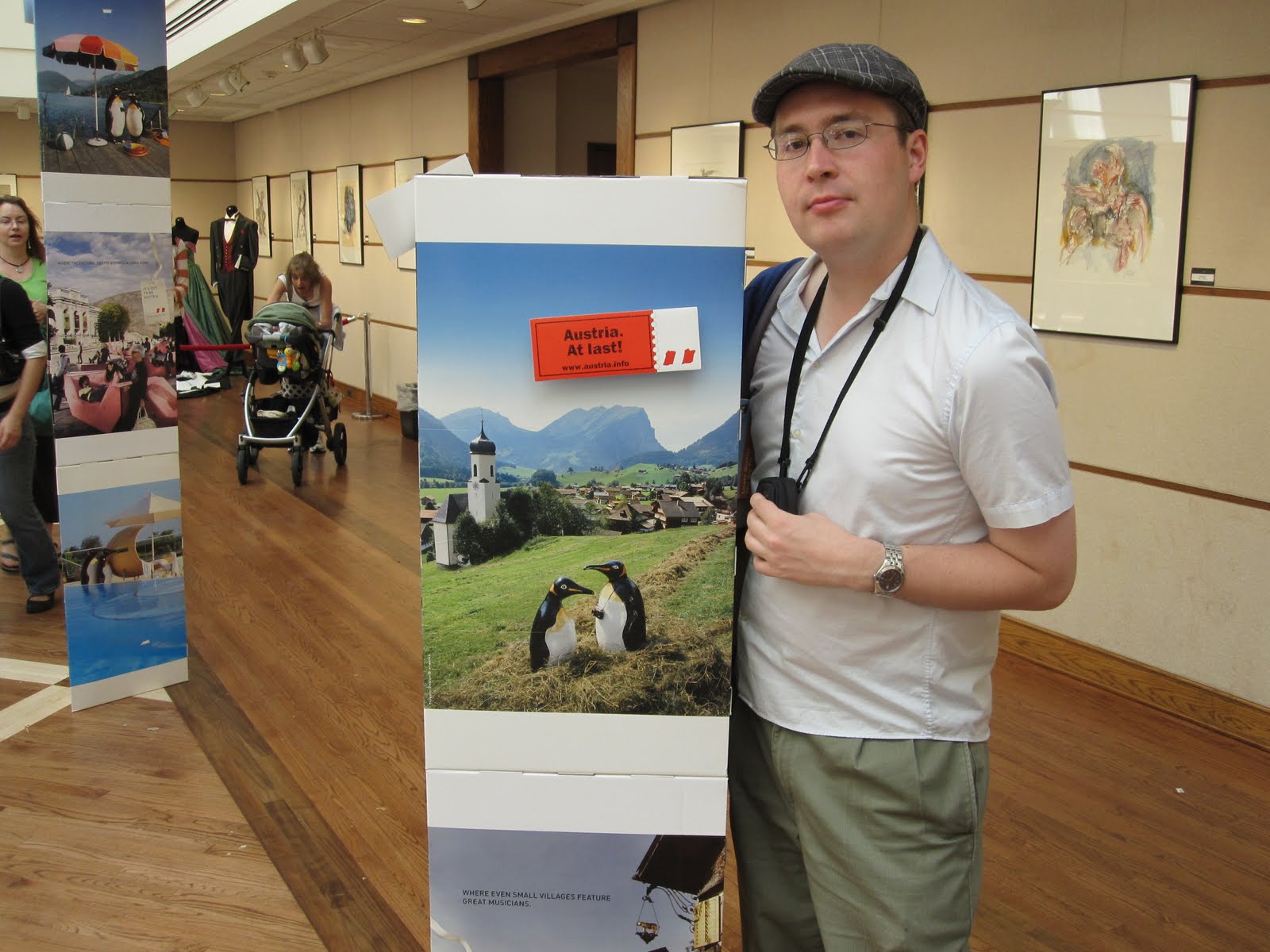
The day was hot but windy, and my eyes were being continuously attacked by specks of dirt and plant matter. The lines for the shuttle buses between the embassies were very long, which is why we decided to skip the UK and take the Metro to Van Ness and visit the Slovak embassy. Central Europe – Austria, Hungary, the Czech Republic and Slovakia – are based much further to the north than the rest of the EU, in another cluster of chanceries which also includes Israel, Pakistan, Bangladesh, Egypt, Nigeria, and the United Arab Emirates. It appeared that there was a long line for Austria and no line at all for Slovakia (it turned out that the line was for the shuttle bus). But Slovakia was nice, children in national dress handed us helpings of dumplings and sauerkraut, a traditional band played, arts were on display, and the backyard had a Friends of Slovakia Wall of Honor. I had my picture taken with it, as a friend of Slovakians (and housemate of one of them). Slovakia’s best friend, however, is US Steel, which was honored on about half of 50 or so plaques. We went back for more dumplings. Slovakia had limited tourist information – mostly about its skiing – and not much about alternative energies. Robert Fico’s government has decided not to close old nuclear plants near the Austrian border that Slovakia was supposed to shutter when they gained entry to the European Union. Austria was not pleased.

With plates of dumplings and sauerkraut in hand, we moved on to Austria, where we surprised by the lack of the line. Given what the people downtown were experiencing, we had clearly made an enlightened decision in coming to spend our time with Central Europe. However, there might have been one good reason Austria had no line – they were already out of strudel. But I didn’t mind, because there was still free wine, free coffee, free information on master’s programs in History of South-Eastern Europe and free tourist publications about hiking in Tirol, which has many gorgeous mountain landscapes and women.

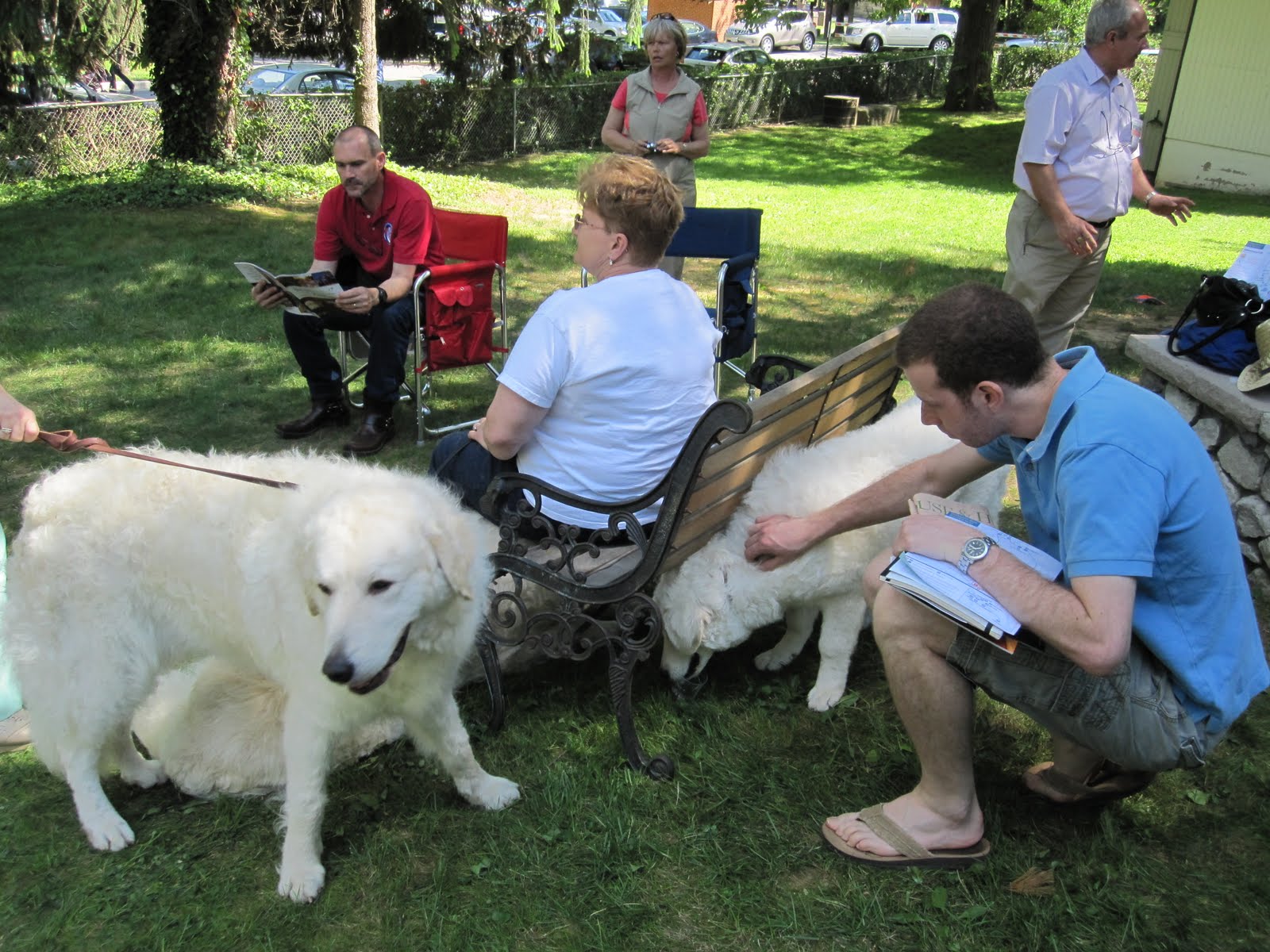
The bus line was still endless, so we followed a bevy of chattering Fräuleins back towards Connecticut Avenue, where Cory left us to go read at his restaurant before his shift. Ben and I continued on foot down the hill to the edge of Rock Creek Park, where the Hungarians and Czechs have embassies on Spring of Freedom Lane. Outside the Hungarian embassy lounged a number of fine specimens of the Kuvasz, a beautiful white Hungarian dog, and the Vizsla, a less beautiful in my opinion but apparently also nice Hungarian breed. Inside we saw displays of lace and china, and a couple performed a Hungarian dance in traditional dress. The couple then offered to teach the dance; I was more interested in the goulash and wine but at this embassy you had to pay for the food. Perhaps wisely, given that Hungary has been the subject of an IMF rescue since 2008.

We walked back up the hill to the Czech campus. Young women in traditional dress greeted us at the entry, we moved through the building without spending much time with the modern Czech designs on display to get the free beer – a generous full glass of Pilsner Urquell rather than an ounce of booze like most samples today. We sat on the sunny hill with many others, drinking our afternoon beers, and watched a cluster of red, white and blue balloons escape into the sky. We just missed getting to go up the path to tour the ambassador’s residence as a woman put a chain across the gate as the clock struck 4.

Enough European embassies for the day, I suppose. I took the Metro home with several pounds worth of tourist pamphlets and informational booklets wrapped inside my jackets and passed out on the couch. If I’m still in Washington next May, I will definitely embark on another day of touring the embassies of the European Union. As long as the European Union is still here then… (don’t panic, it will be).

Friday, March 12, 2010

British History book review

Hey again. I haven't posted in a while but I've been meaning to put up this book review I did for my Modern British Politics class on an interesting history book by a novelist. I'm off to Texas in an hour or so, for a week, so hopefully this will hold you over and then I'll come up with something else interesting. The book is Our Times: The Age of Elizabeth II by A.N. Wilson, and it was published in 2008.

This is the third volume of a history trilogy, covering everything about Britain since Queen Elizabeth II took the throne. A.N. Wilson’s thesis is “the Britain of 6 February 1952 is not merely different from the Britain of today – it has ceased to exist.” Why? There are a multitude of reasons, but going through the book, the chief ones appear to be Roman Catholics, homosexuals (more specifically, the leaders of the nation who fell into these categories) and immigrants. This is slightly unfair to the author, but Wilson’s bugbears are clear, and I’m being no more unfair to the author than he to the subjects of his survey.

Our Times can be viewed a history as a polemic, or a bad history book written by a novelist, which it indeed is. The book is clearly meant to be entertaining, full of amusing vignettes and risible prose, but it is most often risible because it is ridiculous. The decline of the Church of England and the Empire and the supposed imminence of Scottish independence (Scottish nationalism is dubbed “wandering drunk into a rootless future” on page336) are Wilson’s favored reasons for the “disappearance” of Britain, perhaps fairly obvious and well-documented. The reductions of the national rail network and changing British landscape are more interesting explanations which Wilson cites. And then there’s Europe. Wilson is one of those Brits who thinks the European Union and submission before Brussels is a terrible idea and overreliance on America is also bad. Does he have a realistic alternative to these two options? Not really.

While Wilson is clearly a Conservative politically, but turns a sharp pen on all and sundry, attacking them for age (Churchill), looks (pretty Eden and ugly Thatcher), being cheated on by their spouses (Macmillan), and other such personal grounds as well as a few political ones. If a few Tories stand out as decent leaders – Wilson is actually quite a fan of John Major and worships Alec Douglas-Home – Macmillan and Heath (the latter for the unforgivable sin of signing up Britain to the European Economic Community) were terrible people who destroyed Britain. Labour is to be mocked, of course, although Gordon Brown’s spell as Chancellor of the Exchequer is praised (he did preside over a healthy economy and keep Britain out of the eurozone)… his premiership not so much.

Throughout the book, psychoanalysis of notables based on anecdotes and rumours is given greater weight than more serious analysis of policy. In one passage Wilson surveys the sexuality of Britain’s 20th Century leaders and concludes that John Major, whose adultery was revealed by his mistress, was the first British prime minister to have a sexual nature since David Lloyd George, although throughout the book he pushes rumors that his biggest targets of derision – Macmillan, Heath, Blair – were secretly homosexual. Wilson actually writes that greater ease for gays to live openly as who they are is one of the improvements from old Britain to the country-but-not-society which has replaced it, but the weight of the innuendos make Our Times fall on the gay-bashing side of the scale.

Wilson particularly hates Catholicism, which to me was the most striking part of the book. A typical example, on the comically presented figure of George Brown, foreign secretary under “Hawold” Wilson: “He died in 1985 of cirrhosis of the liver, having become a Roman Catholic.” Funnily enough, according to Wikipedia, Wilson once converted to Catholicism, also going through an atheist phase before returning to his present devotion to the Church of England. There is nothing particularly extraordinary in his treatment of immigration and multiculturalism, which is less extreme than a lot that is out there. However, he is sometimes creative with it – New Labour’s legislation banning foxhunting and smoking in the workplace and pubs is compared to the Koran, which “should perhaps have made the British more capable of understanding the Muslims, who follow a scripture which is almost devoid of the narrative interests of the Hebrew Bible, and is largely injunctions and prescriptions” (365).

Thatcher receives one of the more interesting treatments. Wilson compares her rebellion to that of the Sex Pistols, citing that Johnny Rotten said in 1977 “You don’t write a song like ‘God Save the Queen’ because you hate the English race. You write a song like that because you love them, and you’re sick of seeing them mistreated.’ (264)” And both of them were redheads. He cheers her premiership, but he also gratuitously insults her looks, and goes over the top on her post-premiership: “Now she returned from the dead, having lost what vestiges of political nous or personal niceness she might once have possessed. Like a witch at a christening, she wanted to curse the baby whom she had at first suckled as her natural heir [John Major]. And she who had forced through British membership of the European Union [in Heath’s government] now became the High Priestess of the Eurosceptic Cult, screeching her strange imprecations against each and every manifestation of ‘compromise’ from the government…” (312). Interesting – hardly objective history, but Wilson is no Hunter S. Thompson, either.

There are some better moments in the book. The last several pages on the disappearance of Britannia are well-written and fairly convincing. Prince Charles is portrayed as a very decent and admirable man if somewhat politically tone deaf in a strikingly fair chapter on the most famous marriage of the Second Elizabethan Era.

But when the cover has been shut, one comes away with the impression that Wilson thinks postwar Britain has been a march of mediocrity mitigated only by the exceptions of Douglas-Home, Thatcher, Major and Charles in the realm of politics and Benjamin Britten and the Rolling Stones in the realm of culture (with the rest of the United Kingdom contributing the great man that is Rev. Ian Paisley). I’m sure there are some people who agree with him, but if he meant to be taken seriously, he should have treated his subject more seriously. Then again, this is history by a novelist, which might not have been taken seriously anyways, and salaciousness is a good way to sell books.