Showing posts with label United States. Show all posts

Wednesday, April 9, 2014

Left Out in the Cold: The Problematic Partial Inclusion of Europe’s East

Europe will always be unfinished, because it is an idea as much as a geographic expression, and a rather idealistic one at that.

The European Union and a few countries which opted not to join, like Switzerland, Norway, and Iceland, have their problems – structural economic imbalances in the EU which threaten its sustainability, nationalism on the rise, democratic regression in countries like Hungary and Romania – but overall these countries are still among the wealthiest and the freest in the world.

The geographical dilemmas of completing a Europe “whole, free, and at peace” remain, however. The peninsulas and islands jutting into the northeastern Atlantic can be pretty sure they’re part of Europe, as can anyone living anywhere near the Alps. But the seas and straits between Gibraltar and the Caucasus and the Ural Mountains are a pretty arbitrary divide. The problem of only partial inclusion in Europe has been particularly damaging for the more than 260 million citizens of the Russian Federation, Turkey, and Ukraine.

The EU has its reasons to consolidate its troubled project rather than continue to expand to new countries. However, Western Europe has a record of sending contradictory messages to the countries in the continent’s east. These include extending candidate status to Turkey in 2005, then electing Angela Merkel and Nicolas Sarkozy with their “privileged partnership” and non for Ankara; refusing to confirm the potential of future membership for Ukraine and Moldova, despite the EU treaties opening such potential to “any European State” which respects European values; expanding visa-free travel to all the Christian countries in the Balkans before any of the Muslim countries; and rhetoric from European Council President Herman Van Rompuy about European unification’s roots in Middle Ages Latin Christianity, which dismayed Bulgaria. 

With Catholic Croatia now safely in the EU, 23 years after Germany unilaterally recognized its declaration of independence, and the four Eastern Christian countries in the bloc (Greece, Cyprus, Bulgaria, and Romania) in not particularly good standing in the eyes of the older member states, many EU citizens would be happy to keep these borders. These are the realities of how a union of 28 disparate democracies handles the prospect of extending pooled sovereignty to some of more than a dozen countries further east. These nations are seen as less culturally similar to the older member states. Some are quite large, some quite small. They are fragile democracies at best, many fractured, several with breakaway enclaves. All are relatively poor. But ambivalence in EU capitals and mixed messages sent by Western European leaders imposes real costs and dilemmas on the democrats of Turkey, Ukraine, Moldova, Georgia, Serbia, Kosovo, Macedonia, Bosnia and Herzegovina, and other countries.

Extending the hugely successful European integration project to the east was always going to be a huge challenge. There are many reasons to call Europe’s eastern neighborhood policy a great success – the EU has absorbed 11 former communist countries (12 when you include East Germany), with over 100 million people. But some clear failings are seen with the three big countries in Europe’s eastern reaches. Although Russia and Turkey have had a good 21st century in many respects, with incomes and international influence steadily rising since the year 2000, it is not surprising that both of them as well as Ukraine have seen massive protests by pro-democracy / pro-Western citizens in the last three years, which autocratic leaders attempted to crush.

Russia, with 142 million people, was always too big and proud to join the EU. But Russia is clearly a part of modern Europe in many ways – economically integrated, if mostly as a source of energy sent through pipelines and oligarch’s cash spent in London and Switzerland, a member of political groupings such as the Council of Europe and Organization for Security and Cooperation in Europe, a participant in Eurovision and UEFA soccer tournaments. However, democracy failed in Russia, damaged by the chaos of the wild 90s and then smothered in the Putin era by an elite prioritizing its personal short-term interests and willing to ignore a clear long-term downward trajectory masked by high energy prices. European companies and many leaders – above all in Germany and the City of London – tried to look past Russia’s democratic failings and corruption. But if Berlin’s “Annäherung durch Verflechtung” (rapprochement through interdependence) worked, “Wandel durch Handel” (change through trade) failed. Vladimir Putin watched as NATO expanded to Russia’s borders (as was the right thing to do – the Baltics had very good cause to want NATO membership), watched the Western intervention in Kosovo (again, the right thing to do in the face of ethnic cleansing), watched the U.S. invade Iraq (a grievous mistake in which the U.S. ignored some of Putin’s better advice), and suffered a major political defeat in Ukraine’s Orange Revolution. Putin’s anti-Western side was stoked and he transformed from a awkward partner of the West to an adversary. Russia took actions to destabilize its neighbors whenever they tried to move closer to the EU and the United States. Those who claim that the Obama Administration’s “reset” policy was wrongheaded are unrealistic or ideologues – it was necessary to try to mend ties with Russia and progress was made on nuclear reductions, Russian membership in the World Trade Organization, cooperation on Afghanistan, Iran, and Libya. Dmitry Medvedev was not completely a puppet as president. But in 2011 Putin announced he had decided to return to the presidency – a historic mistake for Russia – and responded to subsequent protests with greater repression. At the same time, Russia backed the Assad regime in Syria to the hilt as its killed tens of thousands of its citizens and radicalized the opposition. Washington – and importantly Berlin – have rightly responded with more vocal criticism of Putin and his regime.

Turkey, with a fast-growing population of 80 million, is about to surpass Germany on the population table. Many Europeans see it as too big, too poor, and too Muslim to join the family. Turkish membership would change the EU, and for EU citizens and leaders who follow the polls, the negatives of such a change outweighed the positives – greater diversity, stronger demographics, etc. – which required greater imagination to see. The arguments of those who saw the benefits were drowned out. Turkey’s candidacy has effectively been dead for years, buried by the hard opposition of several member states and ultimately by the subsequent actions of the increasingly dictatorial Recep Tayyip Erdoğan. For many years, Erdoğan advanced democracy in Turkey by pursuing European integration and civilian control of the military. But his uglier side has been unavoidable in the last year, as his response to the Gezi Park protestors made clear to the world that he had a purely majoritarian view of democracy and did not respect those of his countrymen who disagreed with him. Challenged by a corruption scandal, Erdoğan has responded with purges in the criminal justice system and banning Twitter. He may have substantial support, as the most recent elections again confirmed, but at this point he is clearly damaging Turkey’s democracy.

Ukraine, with 44 million people, is where the autocrats – Putin as well as Viktor Yanukovych – failed. Corruption is even worse in Ukraine than in Russia or Turkey and the country has been consistently misgoverned. Persistent Russian interference, often using its energy monopoly as weapon, has not helped. Critically, the EU has also refused to make clear whether or not Ukraine could ever become a member, limiting politicians’ appetite for reform. President Viktor Yushchenko made a mad dash for NATO membership, despite such a move (and his government) being unpopular within the country, but at the Bucharest Summit in 2008, Germany and France stopped a Bush Administration push to give Ukraine – and Georgia – a Membership Action Plan. Ukraine’s diversity gave it a more competitive and indeed chaotic political space than many of its fellow post-Soviet states, while it remained a fragile economy with terrible government finances and was walloped by the global economic crisis in 2008. In 2010, Yanukovych, rejected in the Orange Revolution, won a fair presidential election, then surprised many in the West with the aggressiveness of his monopolization of the levers of power. He also made moves which pleased Russia, like unconstitutionally extending the lease on the Black Sea Fleet’s base by 25 years. But with the EU offering an Association Agreement including a comprehensive free trade deal, Yanukovych balanced Brussels and Moscow for his own gain as long as he could. In November 2013, his time ran out, and he chose Moscow and gave impetus to the EuroMaidan protests. If he hadn’t used violence against the protests when they were relatively small and imposed draconian “dictatorship laws” in January 2014, Yanukovych might still be in power. Instead, he ended up fleeing in February after several bloody days in Kyiv and an abortive deal brokered by the EU. Ukraine swung west and an incensed Putin invaded and annexed Crimea. Now Ukraine faces major difficulties in maintaining control of its territory even without Crimea, given the activities of secessionists in the east directed and/or inspired by Moscow, while its economy remains on the brink of collapse, elections must be helped, and difficult economic reforms must be implemented.

So all three countries are severely troubled. Russia and Turkey look more autocratic than they have in decades, while Ukraine reached that point earlier in 2014 and currently remains at acute risk of state failure. All three are divided countries, their places in today’s Europe – which for people many means the EU, NATO, or both – are vexed. The reasons for this are manifold, the products of geography, history, economics, and domestic politics and foreign policy in dozens of countries. China’s economic performance over the past three decades has given autocracy a good name, while Putin’s model of so-called “sovereign democracy” has inspired imitators. The United States, leader of the free world, allowed its financial system to blow up the world economy, setting some countries back by a decade, and characteristically did nothing to deal with the root causes of the problem. Both the U.S. and the EU are distracted by internal problems, some very serious, and fatigued with foreign policy and enlargement. But Russia and Turkey heading fast in the wrong direction and Ukraine in chaos are very dangerous indeed for Europe and its allies across the Atlantic.

It is in the enlightened self-interest of Europe and the United States to help Ukraine stabilize and succeed as a less corrupt democracy in which citizens can meet their aspirations and to incentivize democratic development and European integration in Russia and Turkey. But success will require more creativity and generosity than has been in evidence in recent years. 

Sunday, September 11, 2011

Notes from the 9/11 Decade

I saw the World Trade Center towers for the last time in late August 2001. My family was driving me up to Maine for college and we took a scenic route through New York, I think through Brooklyn (my NYC geography wasn't great at the time). Several weeks later I came out of an 8:30 a.m. American history class at Bowdoin, learning about the early Cold War, Paul Nitze's NSC-68. I heard a stray remark about a plane hitting the World Trade Center. I didn't think much of it, imagining a small plane accident like Yankee pitcher Cory Lidle's a few years later. But when I tried to check the news online, none of my regular sites were working, so I turned on my roommate's TV. Then I alerted most people on the floor of my dorm. I watched the towers collapse. I couldn't eat much for a few days.

A few weeks later, I was on a camping trip in Acadia when the United States attacked Afghanistan. I was less worried than most of the others in the car. It was a just retaliation against the country harboring al Qaeda. I didn't imagine that US troops would still be there a decade later in the longest war in American history.

In 2003 I was studying abroad in London during the march up to war against Saddam Hussein's Iraq. I never believed the Bush administration's case for war. I did not trust or respect the president, partially for his politics and style, partially because I was 19, it would be a few more years before I forgave him for coming into the office in an illegitimate fashion with the Florida debacle, even though it wasn't really his fault. But the main points were that I knew there was no link between al Qaeda and Saddam and that I did not believe that preemptive war could be just or legal, at least not without the blessings of the United Nations. I admired Tony Blair at the time, he was the most eloquent public figure I had seen before Barack Obama, and he could make the case for the war in a way that almost convinced me. But then President Bush would open his mouth and drawl about Saddam "showing his cards" and I walked off to protest with more than a million others in Hyde Park. When the bombs started falling I was in Amsterdam for the weekend and ashamed to be an American. As a march of anti-war protesters went by I shed my North Face jacket and tried to look European in a purple-brown sweater.

Bush's reelection in November 2004 was another moment of despair. I knew almost no one who liked or would even defend the president and his record, and yet he won the popular vote decisively (The Democrats' lackluster candidate John Kerry nearly won the election due to a close vote in Ohio, though). The next two years were terrible for the president, however. Bush's second inaugural address is worth a read, especially in the context of the changes today in the Middle East. America's power was already past its peak - which was in the 1950s, around the time my parents were born, although the 1990s represented a new peak - and we would never return to a pre-9/11 sense of security. But the laissez-faire candidate who had campaigned against nation-building had become a war president who fully embraced Wilsonianism with his "freedom agenda." This was a crusading president whose country still looked strong. Months later, Hurricane Katrina destroyed that president, with FEMA's failures and television cameras exposing scenes that many people worldwide did not believe could happen in America. Iraq got bloodier and opposition rose.

I taught German students, a few of whom were the children of Turkish or Iranian immigrants, at a high school in Hamburg in 2005 and 2006, on a Fulbright grant. The students told me they hated George W. Bush, some said they didn't like America. I explained that myself and many other Americans didn't like Bush either or agree with him on Iraq, that the country was divided but that we had freedom of speech and a rich history of dissent, I told them about Henry David Thoreau going to jail for a night rather than support the Mexican-American War with his taxes, I played them Bob Dylan's "Masters of War." They warmed up to me.

I love my country though I had very strong feelings against the ruling party. I was in Hamburg for the World Cup, and I bought myself a Team USA jersey, watched many games in an outdoor viewing area, in bars and cafes and pubs, at home, cheered raucously, shook hands with Italians after the US drew with them in a nasty, gritty match. I returned home in the summer. The Democrats swept into power in Congress. Donald Rumsfeld was replaced by Robert Gates (one of the best decisions of Bush's presidency - by and large, the weakened president did a much better job in his last two years).

I never watched Barack Obama's speech at the Democratic Convention in 2004. By summer 2007, Mark Warner had decided not to run, Bill Richardson didn't look like he was going anywhere, and while I still hoped Al Gore would jump into the race, I couldn't count on it. I read Obama's Dreams From My Father to confirm a hunch and embraced his candidacy over Hillary Clinton's and John Edwards'. He was very smart, had an inspiring story, eloquent speaker, I agreed with him on most policies (and still do), and I understand his temperament (and still do). He had the potential to become one of the great presidents in American history, to recover what we had lost of ourselves at home and abroad over the past decade and longer. I obsessively followed the primary and its results, I could tell you who every member of Congress had endorsed. I campaigned for him in Maryland, Ohio and Pennsylvania. On election night, I was watching at a party hosted by the American Embassy in Rome, having moved to Bologna, Italy, to study international relations. Most of us students at the Johns Hopkins University's Paul Nitze School of Advanced International Studies, at least in the Bologna campus, supported Obama. Some cried when he won Ohio and sealed his election. I was elated as I wandered the Eternal City at dawn. A bright future for America and the world had opened up, and working in international relations, I was going to be a part of that somehow.

Three years later, however, the economic crisis that Obama inherited has not been solved, and a double-dip recession looms when the Eurozone crisis reaches a breaking point, if not sooner. I had made Washington, DC my home by the time the Tea Party rose up to shake my faith in the possibility a brighter future for my country. I still strongly support President Obama. But the character of the United States remains conservative enough - in both parties - and the money flowing into politics corrupting enough and the media useless enough and the Republican Party has skilled and cynical enough tacticians and the president cautious enough that Obama's will not be a great transformative presidency. The left in America is instead facing a rearguard action to preserve decades-old social programs, environmental protection, and worker's rights. Wall Street will not be controlled by regulation. The fundamentals of the American economy are not strong, when the economy grows it produces growth for too few, and I have little hope that people with power will not block the situation from being substantially improved. The debt ceiling crisis was a turning point. The country is headed in the wrong direction, and it is heading in that direction because the power of the right, even controlling just one house of Congress and the Supreme Court. Austerity will make our problems worse, not solve them. Sometimes you can only laugh to keep from crying about the situation, this is why comedian Jon Stewart has become the leading voice of progressives' outrage.

I live in Europe these days, and was woken up around 3:30 a.m. on May 2 by the beep of a news flash on my iPad. I followed the rumors on Twitter and then President Obama announced that Osama bin Laden had finally been killed by our SEALs. I was proud and wished I had been back in DC to run over to the White House where Americans were celebrating. The death of al Qaeda's leader punctuates the end of the 9/11 decade. We can reflect now, on September 11, 2011. The men who killed thousands and changed our world have been brought to justice. With the Middle East transforming at a rapid rate in 2011, we're in a new chapter of history.

So what shall we conclude from the results of the 9/11 decade? I'm unfortunately fairly pessimistic.

Al Qaeda has been largely defeated - at least the core group. But there are offshoots, like the one we fought in post-invasion Iraq. Yemen and other failed states pose a threat because of jihadist terrorists operating there. And al Qaeda got much of what they wanted. They drew the United States into bloody wars in the Middle East and Central Asia. The world economy has been damaged and its center of gravity shifted away from the West.

The war in Iraq was a strategic mistake. America won the war, but at too dear a price. The new Iraq could become a proxy of Iran. John Maynard Keynes once wrote "it is not sufficient that the state of affairs which we seek to promote should be better than the state of affairs which preceded it; it must be sufficiently better to make up for the evils of the transition." This is a key question for the transitioning Middle East, for many Iraqis, their new life will not be sufficiently better to make up for the things they have lost in recent years.

Afghanistan, the just war, looks to have been lost between 2002 and 2009 if it was ever winnable, largely because resources were shifted to Iraq. The real war against al Qaeda in Central Asia is being fought by the CIA in Pakistan. The decade-long effort of the US and its allies in Afghanistan has definitely improved things for Afghans, in the balance, but it has also likely weakened the state in Pakistan, a larger, nuclear-armed country full of anti-American extremists.

With the Middle East in turmoil, there have been triumphs for democracy and the human spirit as dictators have fallen. The fall of the terrible Muammar Qaddafi in Libya is the most positive development, though that country still risks becoming Somalia-On-the-Mediterranean. Horrific violence continues in Syria and regime change is far from certain there. It is hard to predict what the future will look like in Egypt and the other countries. As a recent essay in the New York Review of Books, points out, revolutions eat their children. Israel, under the leadership of Binjamin Netanyahu, at the end of the 9/11 decade, at the end of a decade of Recep Tayyip Erdogan and his AK Party transforming Turkey into a more democratic but more Islamist state, and nine months into the Arab Spring, is as isolated as it has been in decades.

The United States of America has spent trillions of dollars on national security in the last decade - wars, concrete barriers in our cities, unreasonable security measures around our embassies and in our airports. Many of these measures make us safer, some, like the war in Iraq, have the opposite effect. Al Qaeda's attack has done too much to change American life. The occasions where we have thrown away our principles in the name of security have damaged us in the eyes of the world, just as the crisis of our much lauded and copied economic system spread to damage the economies of countless other countries, weakening their faith in America. Humiliating visitors to our country and building ultra-secure castles to house our diplomats abroad damages our soft power.

The optimistic side? New York, especially Lower Manhattan, is doing fine. So is Washington. We can absorb attacks, as Londoners did during the Blitz. Fight our enemies abroad in the shadows, with intelligence and drones and Stuxnet and the like, but not with torture. We shouldn't live our daily lives in fear of low-probability attacks. We have to face up to the real greater challenges, rebuild our strength at home, and manage our inevitable loss in relative power overseas as other countries grow faster than we can. The country's challenges are real and they are dire. But terrorism is not that close to the top of the list. Becoming the country we want to be, living up to our ideals and our great potential - that needs to be our priority.

Monday, December 6, 2010

Embassies of Berlin

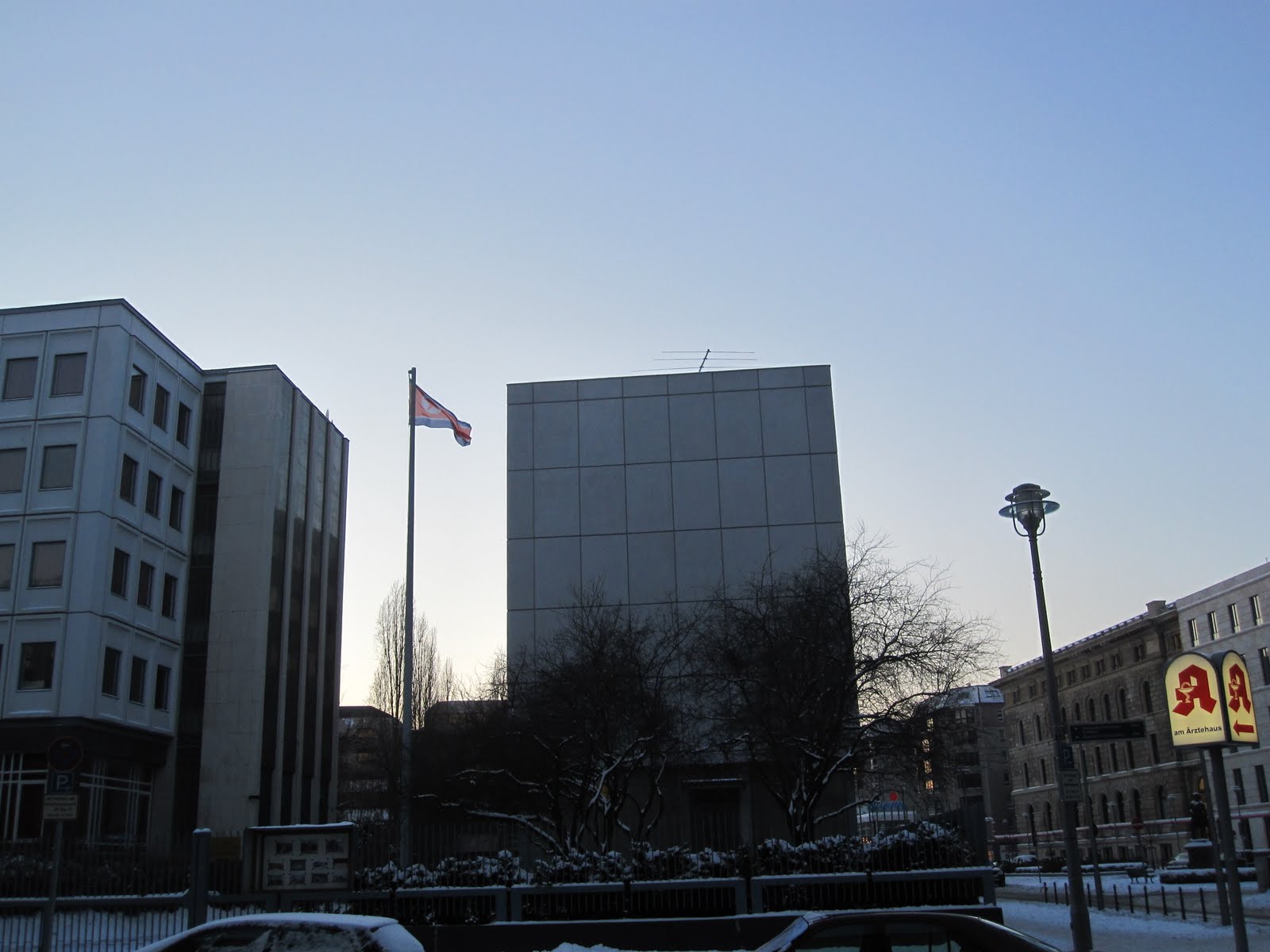
I spent about 24 hours in Berlin on Saturday and Sunday morning, a break at the end of 72-hour business trip (it was supposed to be 96 hours, with more than 3 hours in Berlin before I took a train to the Rhein, but my flight to New York was delayed and I missed my connection). And when I ran across this, I reverted to my old habit of photographing embassies. Yes, that is the Embassy of the Democratic People's Republic of Korea, we don't have one of those in Washington. It is unsurprisingly on the eastern side of where the Berlin Wall used to run. I discovered the large Czech embassy (and wondered if it was a renovated Warsaw Pact leftover or a new building) nearby. I resisted going overboard and only photographed two of the embassies in Germany's capital, however.

Unter den Linden, the great avenue of Berlin, runs from the Brandenburger Tor (the city gate where Reagan told Gorbachev to tear down the wall) on past Humboldt University towards the Museuminsel and Alexanderplatz. Called Mitte (it means "middle"), the area was the showpiece of the East German capital and I've enjoyed watching it change since my first visit to Berlin in 2003, when I lived there for a month (this was my fourth return). Near the Tor is a Starbucks just 100 meters into the former communist country, like a monument to capitalism. But about 200 m further on, a whole block is dominated by the Russians: their embassy and a large Aeroflot office (featuring their logo, a hammer and sickle with wings).

The Museuminsel, an island in the Spree, is named for the museums at its north end but also features the Berliner Dom and the now empty Schlossplatz, where the Palace of the Republic stood after the war-devastated Schloss (palace) of Prussia's rulers was torn down by the East Germans. Berlin tore down the Communist showpiece after 2006, when I last saw it, and is now rebuilding the Schloss, except that the city is broke. I read at an information booth about how Berlin had "lost its heart" when the Schloss was destroyed. I don't agree, Berlin has as much heart as any city I know. The Palace of the Republic had an asbestos problem, but the reasons for tearing it down go beyond that, obviously, although the decision was controversial. At a Fulbright event in Berlin in 2006 I asked a politician about preserving the historical and architectural legacy of the DDR such as the Palace of the Republic and Alexanderplatz. She chose to answer only about Alexanderplatz. I donated a euro to the building of the Schloss anyway, the open space is sort of nice, but I would like to see the finished project on a subsequent trip to Berlin someday.

Back at the Tor, a stone's throw from the Reichstag, there is a square called Pariser Platz. The French embassy stands on the square, but it was named in honor of the capture of Napoleon's Paris in 1814, not the embassy. The new US Embassy is also here on the square, and it makes me proud - it is the type of friendly-looking public embassy in the heart of a city which should be our model, when too often we built fortresses, even in the capitals of countries which are our friends. It was about 17 degrees Fahrenheit, but the gate at night was beautiful, with a Weihnachtsbaum as well as a giant menorah lit-up for the fifth night of Hanukkah. The scene (and thoughts of my next cup of Gluhwein) warmed me. Germany is an especially fascinating place right now, I can't wait to go back.

Wednesday, June 30, 2010

A World Cup History Lesson

Today was the first day in a while without live World Cup soccer - which makes it much easier to concentrate on one's work. The Round of 16 games bought few surprises. Every group winner beat the group runner-up they were matched against, with the exception of the United States losing to Ghana. The officiating continued to be a problem, most notably in the Germany-England and Argentina-Mexico matches, though the superior team clearly won in both cases and would have won even without assistance from the officials. The exit of the United States was disappointing, but understandable given one fairly damning statistic: the US, which accomplished amazing things at this Cup by winning its group and with exciting comeback results, led for exactly 3 minutes out of its 390 at this World Cup, after Landon Donavan scored against Algeria. You can't dig yourself a hole and escape every game. Ghana became only the third African team to make it to the quarterfinals, and will try to become the first to make it to the semifinals, and Uruguay is beatable. But after they knocked my team out for the second Cup in a row and given their pathetic time-wasting measures such as lying down on the pitch without reason in the final few minutes against the US, I wouldn't mind seeing Ghana lose to another team with a compelling story, Uruguay. Uruguay are by far the smallest country to have won the World Cup, about a tenth of the size of Argentina in population, and they won the first Cup, in 1930, at home in Montevideo, then shocked hosts Brazil when the Cup resumed in 1950.

Three compelling match-ups await in the quarterfinals, along with Spain vs. Paraguay (two reasons to root for shock Paraguay victory: their gorgeous superfan, and the possibility of a Uruguay-Paraguay final to determine which nation is the guay-est). I think Spain will play against Brazil or the Netherlands in the final.

But for now, here's some World Cup history factoids since I've gotten so into the all-time records this year:
  • At the first World Cup, 1930 Uruguay, only four European teams decided to sail for South America, and random ones at that: France, Belgium, Yugoslavia and Romania. A odd total of 13 teams competed. The United States had their best ever result: not only did they finish in third place, but American Bert Patenaude recorded the World Cup's first-ever hat trick against Paraguay. Uruguay beat Argentina in the final.
  • For the second World Cup, 1934 Italy, defending champions Uruguay decided not to make the trip to Europe because Italy hadn't bothered to come to South America four years earlier. Mexico made the trip over the Atlantic, but then found out they had to play the United States in a play-in game in Europe even though the Americans had turned in their application late. The US won, so Mexico didn't get to compete. Sorry, that was sort of a dick move. The tournament did take on its long-running 16-team format here. Mussolini's Italy won the World Cup.
  • Only 15 teams got to play in 1938 France, because GERMANY ANNEXED AUSTRIA. Austria was one of the best teams in 1934, so maybe this was another reason for the Anschluss. World War II canceled the Cup for a while, when the fourth edition was finally held, in 1950 in Brazil, Germany was red-carded and had to stay home. The US shocked England in this Cup, but even more importantly, Uruguay shocked Brazil in the final.
  • 1954 saw favorite Hungary lose to Germany in der Wunder von Bern. No small European country like Hungary has ever managed to win the World Cup, this was probably the best shot. Instead, it was the beginning of Germany's impressive haul of championships.
  • In 1958 Brazil won the Cup in Sweden. This is the only time a South American team has won in Europe. The pattern has been Europeans win in Europe, Brazil and Argentina win in South America and Mexico, and Brazil wins everywhere else. Brazil won in 1962 and 1970. England won in 1966 at home against Germany, and had deja vu when a goal off the crossbar, much their winner in 1966, was discounted against Germany on Sunday.
  • If you look at just the last nine World Cups, Brazil, which has won the most total titles, doesn't look quite as dominant. Beginning with 1974, Argentina, Brazil, Germany and Italy have each won two World Cups, France has won one and lost another final in penalty kicks.
  • The tournament finally expanded to 24 teams in 1982 and again to the modern 32 teams in 1998.
  • So right now, 5 Cups for Brazil, 4 for Italy, 3 for Germany, 2 for Argentina, 2 for Uruguay, 1 for England, 1 for France. Four teams look to add to their totals in the next two weeks, while Spain, the Netherlands, Ghana and Paraguay aim for their first Cup first-place trophies.
  • The 20th World Cup will be held in 2014 in Brazil. Guess who will win.

Sunday, June 13, 2010

World Cup, Day 3

When Clint Dempsey's shot slipped through Robert Green's hands yesterday, the American ran down the field pointing his fingers and his eyes to the heavens. With good reason - America's draw against England can't really be attributed to an impressive performance by its strikers or midfielders, and the less said about the defenders the better. Chalk it up to a combination of divine intervention or luck, whatever you prefer, and Tim Howard's top-notch goal-keeping. The draw was a fine result for Team USA. England, who I believed was one of four or five teams that could win the Cup (Spain, Brazil, the Netherlands, England, maybe Argentina), did not look bad but nor did they look like champions.

Germany, on the other hand, just made a statement. Given that their goalkeeper had committed suicide last year and that their next-choice goalie and captain Michael Ballack were out of this Cup, I predicted Germany, along with fellow European powers Italy and France, was headed towards a disappointing Cup, even a first-round knockout in Group D, which looked decently tough before today. But after today's results Germany and Ghana have momentum, Germany looks like a contender, Ghana looks like it might be Africa's great hope, Serbia looks haunted by the prospect of second consecutive bad Cup performance, and you can stick a fork in Australia's ass and turn them over, they're done, with their best player red-carded out of the last two group games.

Little Slovenia is next up for the Americans. When I was shopping for jerseys I considered them, as their mountain outline is either one of the coolest jerseys in the tournament or a bit too Charlie Brown. But Slovenia gear was off-limits because they're in my team's group. I see a US victory and the US and England both in the Round of 16, with England more likely to finish first on goal differential or America drawing one of its two remaining opponents. Then Germany would be a scary opponent, but we'll see how they play in their next two games. Ghana is capable of beating them, and from the qualifiers, you would think Serbia able as well.

And then there's Greece, who I had picked as my second-favorite team in the Cup, based on my Greek roots and the present situation of the country (this job is flexible, last year it was held by home team Germany). I picked them for the semifinals on a whim, but now I don't think they're going to make it out of the group. They were easily outclassed by South Korea yesterday. Which means they're playing for respect, and against history. I've found many interesting nuggets of information in the Goldman Sachs World Cup 2010 and Economics report. One of which is that only one team has played a full six games in the World Cup without winning at least a draw. But Slovenia, Greece, and New Zealand could all have joined El Salvador in this ignominious record by the end of this World Cup. With its victory, Slovenia has more than a snowball's chance in hell of actually advancing to the second round ahead of the United States or England. But Greece and New Zealand could yet match the record. Greece, additionally, has lost four games, and never scored a goal, with 12 goals against it. Only Zaire, which was outscored 14-0 in its one Cup, has a more lopsided history. El Salvador's goal differential is 1-22. To escape ignominy, Greece must beat or draw mighty Argentina or Africa's largest county, Nigeria, which has a very good keeper. So good luck Greece, you'll need it.

Friday, June 11, 2010

World Cup, Day 1

Since the last World Cup, I have mastered the arts of international affairs (incidentally, this is the excuse I have for not posting for a month - celebration around graduation). So I came up the following formulation: in the world of soccer and in the international system, the roles of the United States and Brazil are reversed. In the real world, the United States is the hegemonic superpower and Brazil is the emerging great power that isn't quite there yet (as the West, Russia and China's response to the Brazil and Turkey-brokered deal with Iran on nuclear energy shows). In soccer, the roles are reversed. The USA is one of the most likely countries who has never won the World Cup to win one this time or in the near future (Goldman Sachs gives the USA a 2.81% chance, ninth most likely overall, behind fellow never-wons Spain and the Netherlands and a bit ahead of fellow dark horses Serbia, Mexico and Portugal). But they are an underdog, and it makes them easy to root for.

It is Day 1 of the World Cup, and while I have not managed to write about the Cup ahead of the start of play, I have been eagerly anticipating this day and am plenty inspired now. I have made my predictions with several brackets, bought a Greece jersey as I have decided to make them my second-favorite team, at least at the start of the tournament (why? because they've been in my thoughts, and I am of one-eighth Greek ancestry, and because I thought it would be fun to wear that jersey at European Studies cocktail parties around graduation; its cooling technology also made it a great choice to wear under the graduation gown), and have washed my USA jersey for tomorrow's match with England. Today I was drinking a Dos Equis at Cafe Citron watching the Cup opener on Univision with a bunch of Mexico partisans before 10:30 a.m. Unfortunately I had to closely watch my alcohol intake during the games today, with an afternoon optometrist appointment, lest the World Cup leave me with several years of headaches from a bad prescription, that would be a truly terrible hangover.

OK, not a game was won today, but the games were quite enjoyable, and host South Africa got a good result, if disappointing considering their chances for more goals. The vuvuzela horns made their presence known, filling bars across six continents with a droning noise to accompany the match and the commentary. South Africa is an easy team to root for, we'll see if they can make it out of the first round. I also like Uruguay, perhaps the most improbable of the seven teams that have won the Cup (Brazil five times, Italy four times, Germany three times, Argentina and Uruguay twice, England and France once). Uruguay hasn't won since 1950, but still, all the other countries that have won are much bigger (Uruguay has about 3.5 million people, Argentina has more than 40 million and the others are larger).

I love the World Cup, it is indeed my favorite sporting event. Four years ago, I was lucky enough to be living in Hamburg, teaching less than 20 hours a week, and had plenty of time for enjoying the full Cup experience, and the fantastic chance to blog about it for the International Herald Tribune (the 2006 blog site is no longer online, and I had technical difficulties posting my writings a week ago, so let me know if you really want to read them and I can e-mail you my copy as Microsoft Word document). Four years prior to that, Team USA's surprise showing made me a World Cup fan. I had to leave home for the airport to fly to Alaska, where I was spending the summer, in the middle of the game against Germany, and did not see the Cup to the end from the Alaskan wilderness, where I was learning the arts of birdwatching and bicycling and hiking on glaciers and living in a tent and drinking my dirty dishwater. But the experience (along with playing youth soccer in Mia Hamm's old league, the Annandale Boys and Girls Club of Northern Virginia) primed me for football fandom when I arrived in London for my study abroad program the next year.

Speaking of England, tomorrow's match is simply the most exciting of the 48 first round match-ups. If any of the 32 teams could play any of the others, North vs South Korea might be most interesting, but that's impossible because they're both from the relatively weak conference of Asia which only gets four slots. Brazil vs Portugal is another great match-up of former colony vs its old master, and the level of football might be even higher there, except that it's a game 3 and chances are both will have advanced already and the stakes won't be as high. So USA vs England is the pick of the group stage. Like many a patriot, I'm predicting a USA upset. It won't be easy though. I really think Germany, Italy and France are all going to have disappointing Cups, which leaves England as one of the strongest European powers. But then there is Spain flying high in recent years, and ever-dangerous Holland.

OK, lest I go on for too long, here are my picks for the cup, from my brackets. I filled out a bracket in January when I first could, and picked Spain to beat the Netherlands in the final (by the way, Argentina, Brazil, Germany or Italy has played in every final, so this would be unprecendented), with the United States and England both making it to the semifinals. In May, I couldn't edit this bracket because I couldn't remember my user name or password, so I just discovered this today, although I remembered I had picked Spain. In my main bracket, my May bracket, I picked Spain over Brazil, with the United States and Greece in the semis. And yesterday, not being allowed by ESPN to enter my May bracket in a fourth group, I chose to go a little wilder on the group stage, and ended up with the Netherlands over Spain simply because I had given my bracket a Dutch name from a Wikipedia article on the Dutch War of Independence and why not (although a Dutch victory would probably give rise to mixed feelings for many in South Africa), with the United States and England again in the semis. So those are the teams I think are going to have a good Cup. And we'll just see what happens.

May Wayne Rooney sleep tonight like Richard III before the battle of Bosworth Field. USA! USA! USA!

Sunday, March 21, 2010

Sunday evening on the Hill with democracy

So today has been the biggest day in this never-ending health care reform legislative effort, with the Democrats getting the bill through the House. I was back at home trying to work on school stuff when Bart Stupak and friends got the executive order they wanted on no federal funding for abortion and could support the reforms. We've won, I thought. (And no, the bill is not perfect. It's not death panels or socialism, it's a centrist bill. A public option would have been center-left, I really wanted that at least, and would have enrolled in the public option. Single-payer is what the true left wanted, and that includes me. But the Republicans have fought the battle for public opinion better because it's easier to smear legislation than to sell it... and they're unscrupulous. But Obama and the Democrats need this to pass for their political future, and it is an improvement to one of America's biggest problems.) And moved by the spirit of history and Obama's one-helluva-speech yesterday to the House Dems and the fine warm weather, I decided to abandon my work and hop the Metro from Columbia Heights and head down to the Mall.

Having read about the Tea Party folk chanting "kill the bill" at Congress, as well as some less savory things at John Lewis and Barney Frank, I expected to see animated Americans waving flags at Congress. And I did, although what I saw surprised me as I walked towards the Capitol from the Archives Metro stop. There were thousands, perhaps 10,000, of Latinos, mostly, wearing white shirts, waving American flags as well as Honduran ones and othes, and they were marching for immigration reform, chanting "Si, si puede." Obama supporters, trying to push him on an issue. I walked up Capitol Hill with them, tried to run across the street to get around the crowd at one point but was yelled at by a police officer, so joined in the march around the north (Senate) side of the Capitol, saw congresspeople waving from the east balcony of the House. Although I saw mounties and many police, the scene was hardly tense, just professionals and a big crowd, no sense of danger at all. I thought, "Well they picked a terrible time to march" given the current focus of the Congress and the country, but was also struck by the patriotism and activism of thousands of hard-working Americans trying to get a better deal in life with the help of their government. Which is the main thing that government is for. These are the people that healthcare reform will help. And I think a lot of the Tea Party and "Obama is a dictator bringing socialism to America" folk have a problem with that.

I'm sure I missed the height of the anti-health care protests, by 6 p.m. on Sunday, the fate of the bill in the House seemed to be concluded in favor of reform. But I was surprised by how few protesters were assembled calling for the bill to be killed, waving American, "Don't Tread On Me," and in one case a Virginian flag. There were about 200 people with signs and maybe another 200 basically watching. Most were anti-health care, but a few had come to support the bill. The signs included "Obamacare=Deathwarrant," "Obama: Communism you can believe in," "Has anyone in Congress read the Constitution," "No government can continue good, but under control of the PEOPLE - Thomas Jefferson," but also "Hope not hate," "People of Faith for Healthcare Reform," "Catholics for Healthcare Reform," "Pass healthcare reform for our life, liberty and pursuit of happiness," "Universal healthcare is a family value," and "Obama isn't Jesus, Jesus was a socialist." One guy yelled at another that he was a bigot and was told that he should go back to England rather than choosing to live in this country, but overall everyone seemed fairly civil to one another, engaged in democratic debate. A woman sitting on a railing was holding a sign telling the Democrats to show courage and pass healthcare reform. I gave her a thumbs up and she looked happy as a clam. Then I set out for the turns-out-to-unfortunately-be-closed-after-3pm Bagels and Baguettes, leaving Congress and the democratic activists to their work and their free speech.